Tennessee bases child care help on state median income, one statewide figure that does not vary by county or reflect what care costs. Here are four income measures for one family, two parents with an infant and a preschooler, and where help starts and stops.
Four ways to measure what a family needs
Federal poverty level
Set nationally from 1960s food costs. Many programs use it for eligibility.1,8
ALICE Survival Budget
Bare-minimum basics with no savings. Child care is priced at home-based providers.1
ALICE Stability Budget
Basics plus 10% savings, enough to stay stable over time.2
State median income
The middle income for a family of four. Smart Steps limits are a percent of it.3
Yearly income, family of four. ALICE: 2024 statewide. State median income: TDHS, federal fiscal year 2027.
Where child care help starts and stops
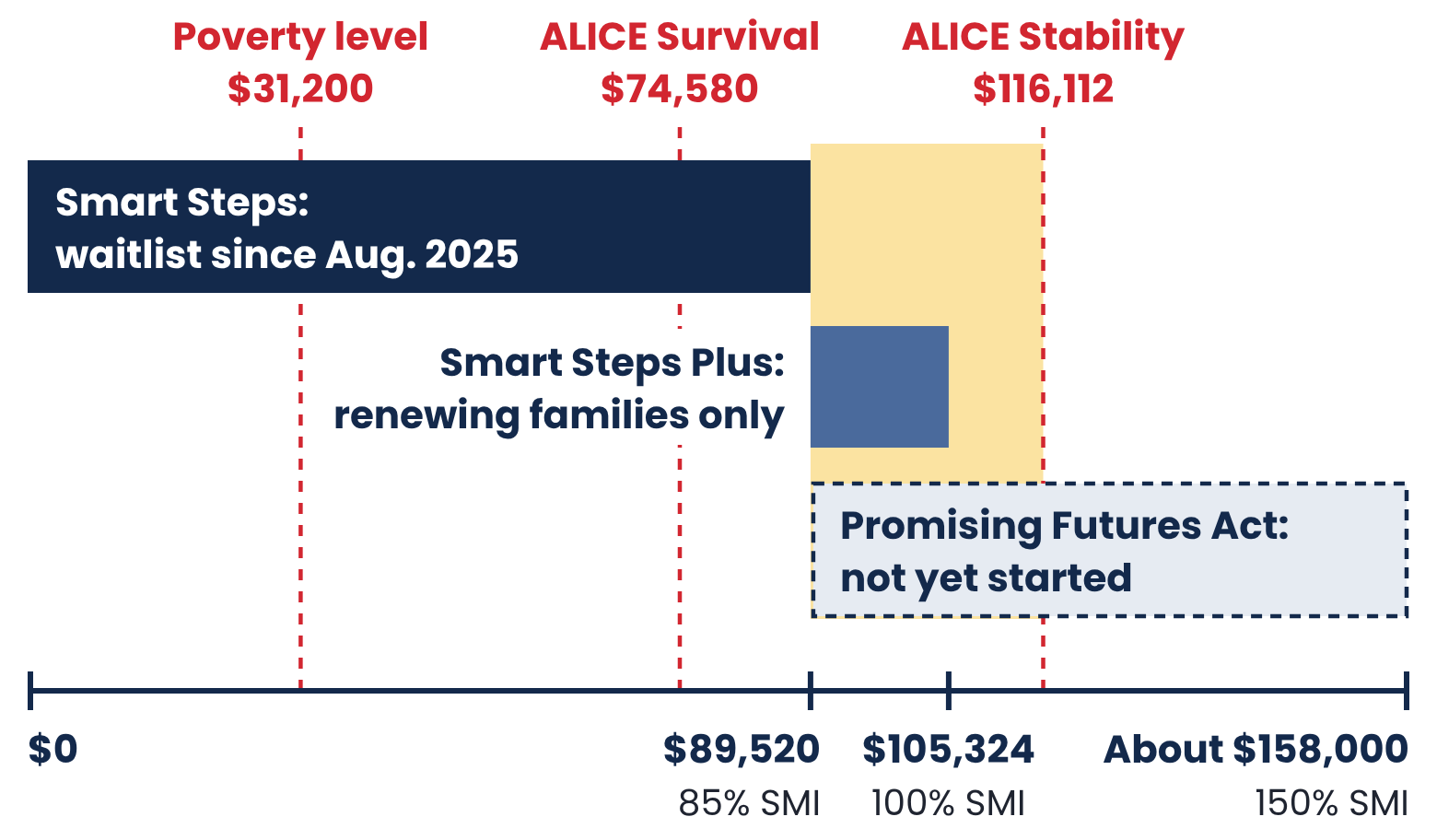
SMI = state median income.1,2,3,7
Too much for help, too little for stability
Families earning $89,520 to $116,112 make too much for Smart Steps but less than ALICE’s Stability Budget. The 2026 Promising Futures Act expands Smart Steps Plus to reach them starting in 2027, but its revenue source is tied up in litigation.7,9
What child care costs at each income level
Center care for an infant and a preschooler cost a median $25,740 a year in 2026.4 Here is that price as a share of income, paid without help.
TQEE calculations from TDHS statewide median center rates: $275 a week for an infant and $220 for a child age 2 to 5. Smart Steps families may also owe the gap between a provider’s price and the state payment.3
What help looks like today
Smart Steps
Who: Working or student families up to 85% of state median income ($89,520).
Family pays: 5% of income, plus any gap between price and state payment.
Status: Waitlist for new applicants since Aug. 26, 2025: 13,835 children as of June 2, 2026. TDHS began inviting some families this fall.5,6
Smart Steps Plus today
Who: Current Smart Steps families whose income rises to 86% to 100% of state median income ($105,324).
Family pays: 5% of income.
Status: In place since Oct. 1, 2025. Closed to new families.3
Smart Steps Plus expansion
Who: Working families who earn too much for existing help, up to 150% of state median income (about $158,000).
Family pays: Sliding-scale scholarship. TDHS sets details by rule.
Status: Can start Jan. 1, 2027, after two other new pilots are funded. The fund’s revenue source is tied up in litigation.7,9
What this means for Tennessee
1 Clear the waitlist
More than 13,000 children were waiting in June. TDHS checks eligibility when a spot opens.
2 Launch Smart Steps Plus
Use other funds while the litigation is resolved.
3 Measure how far help reaches
Report yearly how many families get help at each income level.
About the numbers. ALICE uses 2024 costs, care prices are for 2026 and state median income is for 2027, so today’s income gaps are likely larger. Costs vary by county: in Davidson, this family needs $98,352 to cover basics and $147,060 to stay stable.2 Sources and methods are below.
Sources
- United For ALICE, The State of ALICE in Tennessee: 2026 Update on Financial Hardship, United Ways of Tennessee (2026). Survival Budget, poverty level and household counts for 2024; Figure 3. unitedforalice.org/Tennessee
- United For ALICE, The Cost of Basics: Tennessee, Household Survival and Stability Budgets, statewide and Davidson County, 2024. Accessed Nov. 13, 2026. unitedforalice.org/the-cost-of-basics/tennessee
- Tennessee Department of Human Services, Tennessee Child Care Certificate Program: Income Eligibility Limits and Parent Co-Pay Fees, effective Oct. 1, 2026. State median income figures for federal fiscal year 2027. tn.gov/content/dam/tn/human-services/documents/Income%20Eligibility%20and%20Co-Pay%20Chart.pdf
- Tennessee Department of Human Services, Data Strategies Unit, Determining Child Care Market Rates in the State of Tennessee, Market Rate Survey for federal fiscal year 2026 (August 2026; approved Sept. 11, 2026), Table 3, child care centers, all counties, providers with 50% or fewer subsidized children. digitaltennessee.tnsos.gov/hs_market_rate_surveys/9
- Tennessee Commission on Children and Youth, FY2028 Budget Recommendations: Education and Early Learning (2026). Smart Steps waitlist as of June 2, 2026, citing TDHS. tn.gov/content/dam/tn/tccy/documents/budget-recommendations-/TCCY_FY2028_BudgetRecommendations_4.pdf
- Tennessee Department of Human Services, Update on Child Care Funding: Frequently Asked Questions, updated Nov. 3, 2026. Waitlist start date and outreach to waitlisted families. tn.gov/humanservices/for-families/child-care-services/update-on-child-care-funding.html
- Promising Futures Act, Tennessee Public Chapter 997 (2026), SB 2062 / HB 1979, as amended by House Amendment 1 and Senate Amendment 2; Tennessee General Assembly Fiscal Review Committee, fiscal memorandum on SB 2062 / HB 1979. capitol.tn.gov/Bills/114/Fiscal/FM3354.pdf
- The Sycamore Institute, Financial Hardship and Affordability in Tennessee (Sept. 2026). sycamoretn.org
- Financial Technology Association, declaratory judgment action filed June 10, 2026, in Davidson County Chancery Court, challenging the constitutionality of Tennessee's tax on international money transfers, Public Chapter 1035 (2026), SB 2166 / HB 2502. That tax is the Promising Futures Fund's revenue source. ftassociation.org
How TQEE calculated the figures
Smart Steps limits. Yearly amounts are TDHS's monthly limits for a family of four multiplied by 12: $7,460 at 85% of state median income and $8,777 at 100%. The 150% figure multiplies the 100% monthly limit by 1.5, then by 12. It is an estimate: the Promising Futures Act defines state median income as the Census Bureau's estimate adjusted for family size, and TDHS will set Smart Steps Plus limits by rule.
Share of income. Each share divides the yearly price of center care for an infant and a preschooler by the income shown. The price is TDHS's FY2026 statewide median weekly rate for an infant ($275) plus its median for a child age 2 to 5 ($220), times 52 weeks: $25,740.
Years. ALICE budgets reflect 2024 costs, care prices are from TDHS's FY2026 survey, and Smart Steps limits use state median income for federal fiscal year 2027. Because basic costs have risen since 2024, the income gaps shown are conservative.